January 6th, 2026 | Blog | Events & Industry Updates

Manufacturing in 2025 faced enormous shifts. Automation expanded, production costs climbed, and reshoring has boomed across the country. With factories becoming more connected and more complex, one need became increasingly apparent: protecting critical electronics and equipment to maintain reliable uptime.
As manufacturers plan for 2026, equipment protection will be more than a maintenance concern – it will be a strategic advantage. Explore how evolving manufacturing trends are driving operations toward more proactive and reliable approaches to protecting critical equipment.

Manufacturers continued to adopt advanced technologies this year, including AI-driven analytics and Industrial IoT. A Deloitte study found nearly 46% now use IIoT across their operations, and 29% have fully scaled AI. That means facilities are loaded with sensors, controls, and edge devices. Many of these technologies are made essential to production, yet all of them face vulnerabilities.
More electronics on the floor also means more exposure to heat, dust, vibration, humidity, and power fluctuations. These environmental threats aren’tsmall issues. Equipment failure contributes to roughly 37% of unplanned downtime, where overheating and contamination can often be preventable root causes.
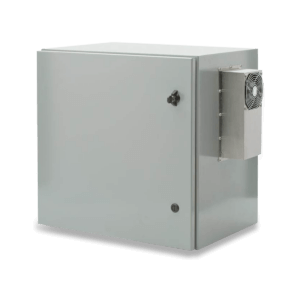
If a PLC, network switch, servo drive, or sensor goes down, production stops. The most innovative automation isn’t helpful if the circuit board running it fails inside a hot or dusty enclosure. As operations prepare for 2026, manufacturers are turning to reliable cooling, filtration, and rugged enclosures as a proven solution to keep sensitive electronics running efficiently and protected from preventable failures.
Reshoring has remained a bright spot in the manufacturing sector. Medius found that in 2025, 69% of U.S. manufacturers reported taking steps toward reshoring, and 93% expect to accelerate that shift in the next two years. It’s a promising trend, but it comes with new risks and challenges for operators to handle.
Many reshored operations land in:
Legacy facilities and challenging climates place additional stress on new equipment, particularly when environmental protections are outdated or inadequate. Intense heat in the Midwest, high humidity in the Southeast, and general wear throughout older buildings all increase the likelihood of electronics degradation and control system failures. When teams are already operating with limited capacity, any preventable failure becomes a significantly larger setback.
As production returns home, the pressures of labor shortages, supply chain delays, and unstable facility environments increase the urgency of maintaining reliable uptime. In this environment, even minor equipment failures carry amplified financial and operational consequences. To support successful reshoring, thermal management and enclosure protection need to be integrated in step with modern manufacturing demands.
 Downtime Economics and the Cost of Failure
Production expenses continued to rise for manufacturers. Accordingto S&P Global’s March 2025 PMI report, manufacturing input prices increased sharply, with the United States seeing the fastest factory input cost inflation among all 33 surveyed economies. A Q3 2025 industry survey also showed that 91% of manufacturing technology executives faced higher landed costs because of tariffs, and 75% were absorbing at least part of those expenses.
In a high-cost production climate like this, even brief disruptions can have a major financial impact. A 2025 study found more than six in ten manufacturers, including those inthe United States, reported experiencing unexpected equipment or process failures in the past year, driving losses of up to $852 million each week across the sector.
Modern robotics, CNC machines, and automated systems represent huge investments. Industrial robots alone cost $50,000–$200,000, and full integration can approach $500,000. When a drive, controller, or sensor fails due to heat or contamination, the repair requires significant expenses – and the lost production time can be even worse.
From everyday machinery to advanced automation, equipment failures can trigger significant financial and operational failure. Yet many equipment failures are preventable – overheating, moisture, dust, and poor enclosure protection frequently sit at the root of costly downtime events. Utilizing thermoelectrically cooled enclosures to protect sensitive equipment is one of the most direct and cost-effective ways to reduce these risks and shield productivity before minor issues escalate into major disruptions.
 Thermoelectric Cooling: Strategic Protection from Shutdowns
Overheating and contamination continued to cause avoidable failures in 2025, especially during extreme summer heat and increasingly unpredictable weather. Thermoelectric cooling is a simple solution for many manufacturers looking to provide stable, low-maintenance protection for sensitive electronics.
Why manufacturers choose thermoelectric protection:
Investing in thermoelectric cooling protects critical electronics and helps manufacturers avoid the expensive ripple effects of unexpected shutdowns.
Learn How EIC’s Solutions Can Support You
The industry made big shifts in 2025: smarter factories, more domestic production, and more investment in automation. But the year also reinforced a strategic lesson: innovative investments only deliver value when equipment can reliably stay running.
Going into 2026, manufacturers can prioritize operational readiness with:
EIC partners with manufacturers across diverse industries where uptime and electronics protection are mission-critical. From rugged field sites to high-tech production lines, our solutions will help keep your operation running smoothly.
In a manufacturing landscape defined by change, the companies that pair innovation with protection will be the ones that stay resilient, productive, and ready for whatever comes next.
Ready to strengthen your operation? Contact EIC’s cooling system experts to discuss the best enclosure protection for your environment.

