October 27th, 2026 | Blog | Product Information
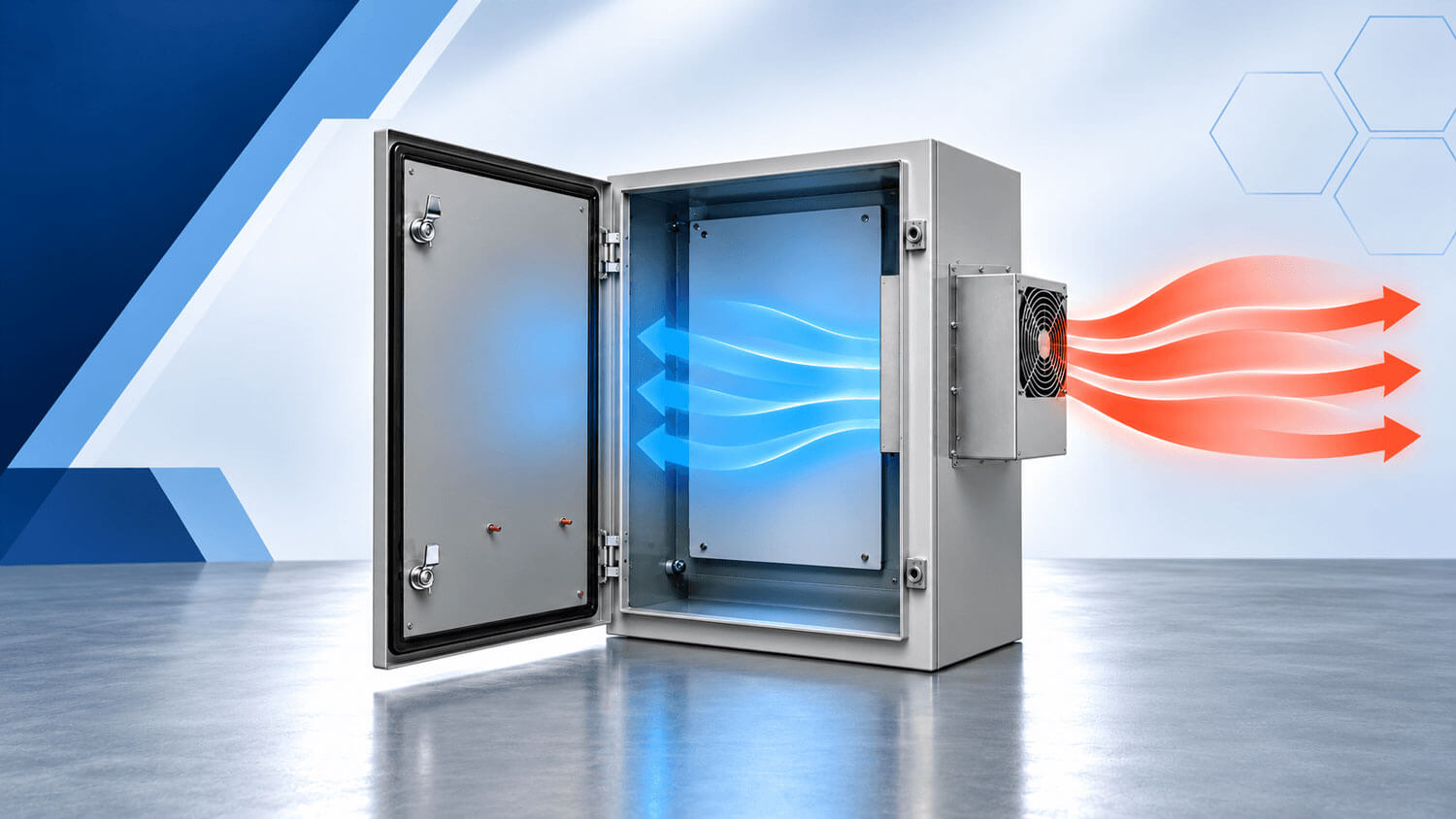
A sealed design helps protect sensitive equipment from dust, moisture, debris, and other environmental conditions. But electronics generate heat as they operate, and once they are inside an enclosure, that heat has fewer ways to escape.
If the enclosure cannot dissipate heat as quickly as it accumulates, its internal temperature rises – sometimes well above the surrounding air temperature. Over time, excessive heat can affect component performance, reduce reliability, and increase the risk of equipment failure or downtime.
Preventing that starts with understanding where the heat is actually coming from.
The equipment itself is one source. Power supplies, drives, processors, batteries, and other components all generate heat during normal operation. Put several heat-producing components into a compact enclosure and their combined heat load can become significant.
Then there is the environment around it. High ambient temperatures make it more difficult for an enclosure to release heat. Outdoor installations can also absorb additional heat from direct sunlight.
That means two identical enclosures containing identical equipment can have very different cooling requirements depending on where they are installed.
For a deeper look at the factors that affect heat load and cooling requirements, see EIC’s Guide to Thermoelectric Cooling.
A common first response to hot electronics is to add airflow. Inside an enclosure, that can help. Moving air can help distribute heat more evenly and maintain a more uniform temperature within the enclosure.
But there is an important distinction between moving heat and removing heat.
A fan circulating air within a sealed enclosure is still circulating the same heated air. If the enclosure walls cannot dissipate the total heat load quickly enough, internal airflow alone will not bring the temperature back into an acceptable range.
Venting outside air can remove heat, but it may defeat the purpose of the enclosure being sealed in the first place. Applications exposed to water, dust, oils, corrosive materials, or other contaminants may need to maintain separation between internal and ambient air.
Closed-loop cooling offers another option by transferring heat outside the enclosure while keeping the internal and ambient air separate. EIC’s Electronics Enclosure Cooling Explained resource provides a closer look at thermoelectric, compressor-based, and engineered enclosure cooling approaches.
Not sure whether your enclosure is at risk? Assess your cooling needs with EIC’s interactive tools.
It is tempting to approach overheating by asking, “How much cooling do I need?” A few other questions should come first.
What is generating heat inside the enclosure? What is the highest realistic ambient temperature? Will the enclosure sit in direct sunlight? How hot can the protected equipment safely operate?
Those answers define the thermal problem.
For example, specifying an unnecessarily low internal temperature can lead to an oversized cooling system. Looking only at ambient temperature can create the opposite problem by overlooking heat generated by the electronics themselves.
A useful assessment should account for:
Once those conditions are understood, it becomes much easier to determine whether passive heat dissipation is sufficient or active cooling is needed. EIC uses these same types of inputs in its cooling-sizing guidance.
There is no single cooling technology that makes sense for every sealed enclosure.
Applications that require active cooling while maintaining a sealed environment may instead use thermoelectric or compressor-based air conditioning.

Thermoelectric air conditioners use solid-state cooling to transfer heat without compressors or refrigerants. EIC recommends thermoelectric cooling for sealed enclosures with low-to-moderate heat loads, including applications where contamination, vibration, or limited maintenance access is a concern.
For higher heat loads or larger enclosures, compressor-based air conditioning may be more appropriate. The decision comes back to the same fundamentals: how much heat needs to be removed, where the enclosure will operate, and what conditions the electronics need to maintain.

If the enclosed equipment can safely operate at temperatures above ambient, a closed-loop heat exchanger may be an appropriate means of removing internally generated heat. EIC’s HE Series Heat Exchangers, for example, are designed for applications in which the enclosure temperature can be maintained at least 5°F above ambient.
An enclosure can look perfectly suited to its environment, while the electronics inside operate under very different conditions.
Understanding internal heat load, environmental conditions, and equipment temperature limits enables addressing overheating before it becomes a reliability problem. And enables you to select a cooling approach based on the application’s actual requirements.
Have the basic application details ready? Use EIC’s cooling tools to start evaluating your requirements. For more complex applications, EIC can work with you to develop an engineered solution around the requirements of a specific project.
Need help with a more complex application? Since 1988, EIC Solutions has specialized in the design and manufacture of thermoelectric cooling systems for industrial, commercial, military, and defense applications. Talk to the Thermoelectric Cooling Experts.
